


When Does a Liquid Become Solid?
TAU Researchers Offer a New Way to Observe the Elusive “Glass Transition”
A scientific discovery by researchers at Tel Aviv University’s School of Chemistry offers a new perspective on a long-standing scientific mystery: how does a flowing liquid suddenly become a rigid, almost frozen material, without changing its structure? This phenomenon, known as the “glass transition,” has puzzled physicists for over a hundred years. The study proposes a new experimental approach to observing this elusive process — by tracking the motion of tiny particles that serve as microscopic “sensors” within the material.
The study was conducted by Prof. Haim Diamant and Prof. Yael Roichman of the School of Chemistry at Tel Aviv University, together with the research group of Prof. Stefan Egelhaaf at Heinrich Heine University Düsseldorf. The findings were published in the journal Nature Physics.
Using colloids to model the transition
The research focuses on colloidal materials — suspensions of microscopic particles dispersed in a liquid — which are considered an ideal model for studying the glass transition. When particle concentration is low, the system behaves like a regular liquid. But as density increases, the particles increasingly restrict each other’s motion, until the entire system becomes “jammed” and acquires the properties of an amorphous solid, similar to glass.
Tiny particles, big insight
The researchers’ key innovation is the use of particularly small and highly mobile particles embedded within a system of larger particles undergoing the glass transition. While the larger particles gradually lose their ability to move, the smaller particles remain mobile, allowing the team to measure how the surrounding medium changes.
Using advanced microscopy, the researchers measured the coordinated motion of pairs of small particles, examining how the movement of one affects the other, along different directions and at varying distances. The results paint a clear picture: in the liquid state, motion spreads over long distances through the fluid. But as the system approaches the glassy state, this propagation is suppressed, and the system begins to behave like a solid that absorbs momentum instead of transmitting it.
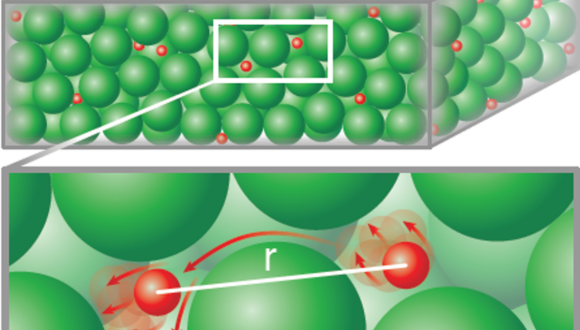
Colloidal Glass
Clear signatures of transformation
The researchers identified three clear signatures of the transition: a pronounced change in how the decay of correlations varies with distance; the emergence of a new characteristic length scale that grows with the material’s viscosity; and even opposing motions between neighboring particles — evidence of the development of resistance to shear, a fundamental property of solids. The experimental findings precisely confirmed theoretical predictions made by the same team several years ago.
Beyond glass: broader implications
The research team notes that, beyond their importance for a deeper understanding of the glass transition, the findings have broad implications. The new method may be used to study gels, soft materials, active systems, and even biological tissues — areas in which it is difficult to pinpoint when a system stops “flowing” and begins to solidify. In this sense, the tiny particles serve as microscopic witnesses to the moment a liquid loses its fluid character.
Prof. Haim Diamant concludes: “The significance of this research lies not only in identifying new signatures of the glass transition, but also in offering a fresh perspective on the phenomenon as a whole. Our findings show that the glass transition is not merely a gradual slowing of particle motion, but is accompanied by a profound change in the way momentum is transmitted from point to point within the material. The use of small tracer particles as hydrodynamic probes opens the possibility of examining the emergence of solid-like properties even before the system actually ceases to flow, and may provide a new tool for studying soft materials and complex systems in which the transition from liquid to solid is difficult to measure.”