


When food, memory and migration meet on the hotline
Shiri Kraus is a chef, owner and founder of The Black Cow restaurant in London, and a graduate of Tel Aviv University’s Faculty of Medicine.
Back when I was studying at Tel Aviv University, roughly a lifetime ago, I genuinely thought I was one of those people who “knew”. I was sure my path was sorted. A nursing degree, a steady job, meaningful work. I was in the A&E at Ichilov, a place that doesn’t leave much room for daydreaming but absolutely teaches you how to breathe fast and make decisions. I loved it. Properly loved it. But love doesn’t always hold up when life decides to change the script without asking.
Moving to London happened fast and with zero warning. I arrived buzzing with a newborn and a sense of adventure but also carrying a very clear sense that something had been ripped away. It slowly sank in that the British system wouldn’t let me keep working as a nurse. The profession I had built, the one I’d given years and far too many sleepless nights to, just vanished. One of those moments where you look in the mirror and think, “Right. Now what?” And the honest answer was, “No idea. We’ll wing it.”
So I winged it. I hopped between jobs that had nothing in common. Comms, PA work, community management, and at one point, strategic consulting for the British government. Yes, I laughed too. All of it filled the hours but none of it filled my heart. I didn’t feel connected to any of it.
Then something shifted. Not some magical Hollywood moment. Just me, sitting at the bar of a restaurant in London. Busy, loud, slightly dim lighting, chef shouting at someone in the background. My friends knew I was miserable, but I never dared say out loud that I dreamt of being in a kitchen. I barely admitted it to myself. They just went for it. Started chatting to the chef, and out of nowhere asked him, “Why don’t you hire her?”
He looked at them, then at me, and asked, “Why would I?”
They said, “Because she’s a brilliant pastry chef.”
He turned to me and asked, “So, are you a brilliant pastry chef?”
I shrugged and said, “Not sure about brilliant, but I’ve always cooked and baked.”
And that was the start of it. They called me in for a trial shift. I walked into the kitchen, felt the heat, the smells, the pace, and something in me finally settled. It felt like finding a room in the house I didn’t know existed.
I started right at the bottom. Peeled potatoes and chopped onions for 6 months. Two young kids at home, late thirties, surrounded by twenty-somethings who could run circles round me. A shameless cliché. It was a proper lesson in humility. Every single day. I learned everything I could. How to hold a knife. How to stay tidy. How to not crumble when someone shouts at you. How to get up and try again. Anyone who was willing to teach me anything, I absorbed it.
Bit by bit, I moved up. Hot pass, pastry, sous chef, head chef. Every step a small fight and a small victory. And somewhere along the way, I met Amir. My business partner, the professional half I didn’t know I needed. He gets food like I do, just from a different angle, which makes things spark in all the right ways.
We opened a tiny catering business that eventually stopped being tiny. Now we’ve got two restaurants and another on the way. Black Cow, an American steakhouse with a Middle Eastern heartbeat. Fire, herbs, bold flavours. Epicurus, a diner that looks at the Middle East with a cheeky grin and sends out shawarma pancakes and big, joyful burgers. Each place has its own personality, but they speak the same language. Food that sticks with you.
And why food? Because food is its own language. It’s memory, science, emotion, connection. It can send you straight back to your childhood with a single bite. We take familiar dishes and nudge them into our world. Colour, flavour, texture, a bit of cheek. Food that feels like home, just with the windows open.
My path is full of stories, some hilarious, some less glamorous. Here’s one that still makes me laugh. Early on, I was working the hot pass in one of Assaf Granit’s restaurants. An Israeli mum and daughter sat at the bar and I started chatting with them in Hebrew. After a few minutes, another customer asked me something in English. I answered her and went back to the conversation. The two of them stared at me and said, “How long have you worked here?”
I said, “About a year. Why?”
They said, “Your Hebrew is amazing.”
And now it’s Hanukkah. A holiday of light and oil and general joy. Everyone’s busy with fancy doughnuts and I like taking a small detour and poking the tradition gently. So here are the Awameh. Small, round, with a little unexpected twist. Crispy on the outside, soft on the inside, with a spiced syrup that makes people lose all dignity. A lovely way to wink at tradition. Familiar, but not quite the same.
Recipe attached.
Beware, though- there is absolutely no world in which you make a batch and don’t end up arguing over the last one.
Shiri Kraus’s Awameh
Crunchy on the outside but sweet, soft and moist inside, these simple-to-make, delicious sweet fritters (also know as luqaimat) are popular throughout the Middle East. No one would know they’re made with mash. Simply pipe the mixture straight into the hot oil and serve dipped in a sweet spiced syrup.
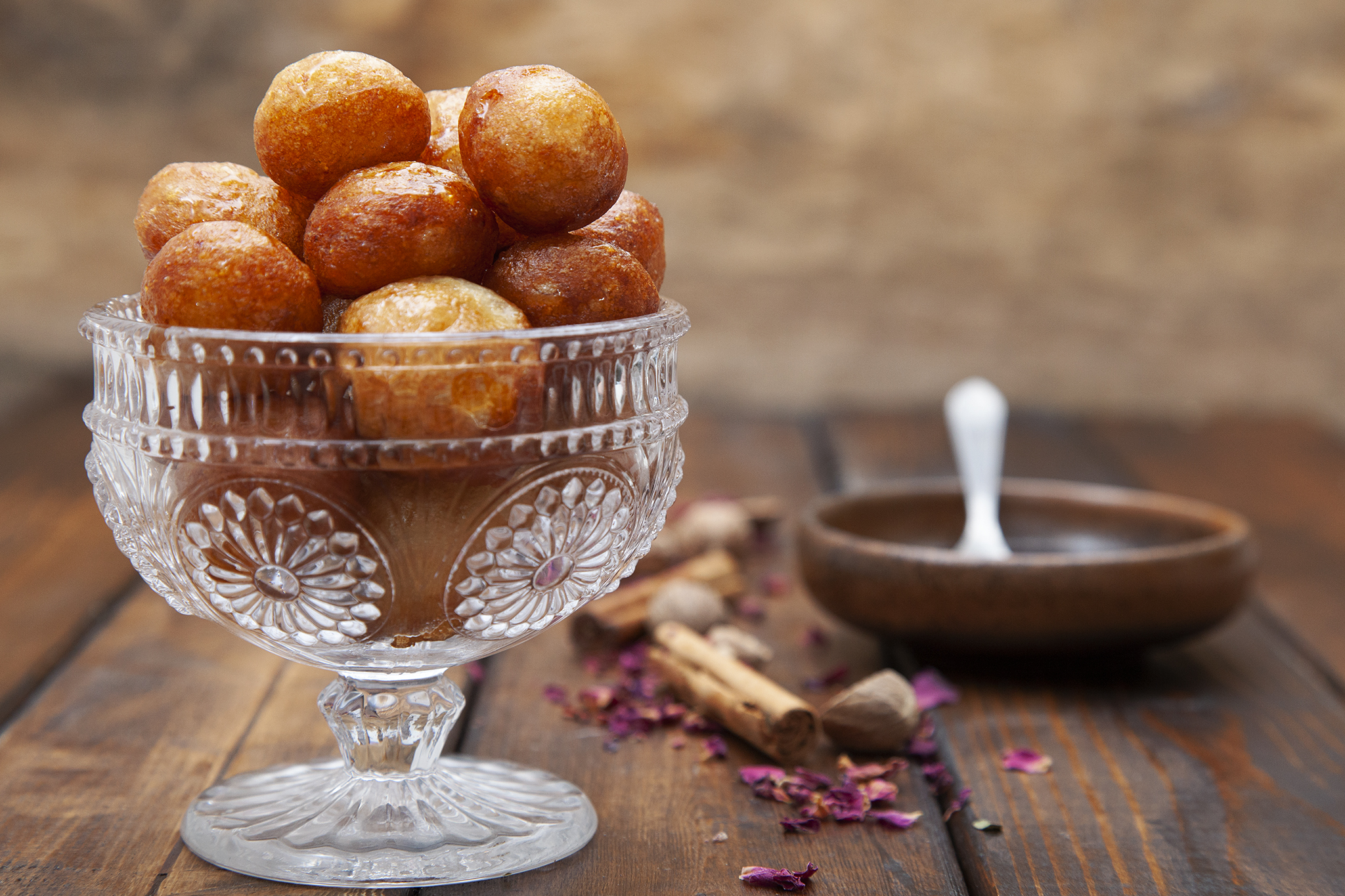
Ingredients:
For the awameh:
- 150 gr of potato (1 medium potato)
- 280 gr plain flour (2 cups)
- 10 gr dried yeast (1.5 sachet)
- 300ml tepid water (1.25 cups)
- 1 tsp sugar
For the syrup:
- 1 cups sugar (200gr)
- ¾ cup water (200ml)
Your choice of one or mixture of the following: cinnamon stick/ 2x cardamom pod/ pinch of saffron/ two cloves/ orange blossom / rose water/ star anise
For frying:
1L plain (vegetable) oil
Method:
- Cook the potato in water until completely soft. Remove and allow to cool slightly, then peel and mash very well with a fork/ricer, to a very smooth and lump-free mash. Use some of the cooking water if necessary.
- Add to remaining dough ingredients to a stand mixer with a paddle attachment and mix on medium for 7-8 minutes. Your dough will be very wet – it’s ok!
- Cover bowl with cling film. Allow to rest for an hour.
- While your dough is resting, make syrup: place water, sugar and flavours of choice in a pot and bring to a boil. Simmer for 5 minutes.
- Mix the dough with a spoon to get rid of trapped bubbles.
- Warm up your oil in a deep pot. You’ll know when your oil is ready if you drop a small amount of dough into it and it rises to the surface with gentle bubbles around it.
- Transfer your dough into a piping bag. Pipe small balls into the oil, pinching them off of the bag with clean, wet fingers. If you don’t want to use a piping bag, simply take small portions with a teaspoon and, using another teaspoon, slide the dough to drop into hot frying oil forming small rounded shapes.
- Fry until golden on both sides (flip halfway through) – about 2 minutes on each side.
- Remove from oil using a slotted spoon, and dip in chilled syrup. You can scatter with coconut flakes or sprinkles if you like.