


Why Did Early Humans Stop Using Massive Stone Tools?
New TAU study suggests the answer lies not in human intelligence alone but in the disappearance of giant animals
A new study by Tel Aviv University researchers offers a novel explanation for a longstanding mystery in prehistoric research: why the heavy-duty stone tools used by early humans for more than a million years disappeared and were replaced by smaller, more refined tools. According to the study, published in the journal Quaternary Science Reviews, this shift was not driven solely by cognitive development that enabled technological progress, but rather by changes in the composition of mammal populations living in the region — most notably the disappearance of animals weighing over a ton (megaherbivores) such as prehistoric elephants, hippopotamuses, and rhinoceroses, on which humans depended for survival.
The study was led by doctoral student Vlad Litov, Dr. Miki Ben-Dor, and Prof. Ran Barkai of Tel Aviv University’s Alkow Department of Archaeology, Entin Faculty of Humanities. Prof. Barkai is a leading authority on ancient Paleolithic cultures. The findings were published in the academic journal Quaternary Science Reviews.
From Giant Animals to Smaller Prey
Vlad Litov: “During the Lower Paleolithic period (approximately 2 million to 200,000 years ago), humans routinely used heavy-duty tools such as handaxes, cleavers, and massive scrapers. These tools were particularly well suited for butchering and processing the very large animals that served as a primary food source for humans throughout this period. However, with the transition to the Middle Paleolithic period, around 200,000 years ago, heavy-duty tools almost completely disappeared and were replaced by smaller, lighter, and more sophisticated tools. Until now, this shift has been attributed to advances in human cognition. In our new study, we propose a different interpretation: the dramatic decline in the prevalence of megaherbivores was the key driver of this technological change.”
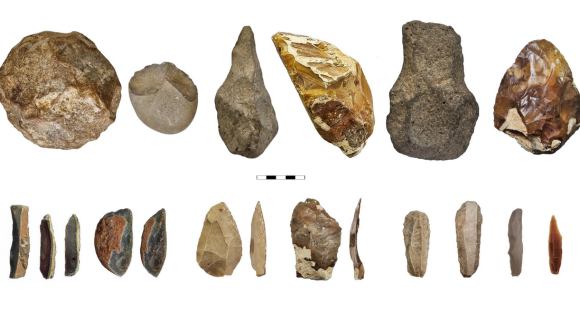
Prehistoric Stone Tool Types
The researchers analyzed dozens of archaeological sites in the Levant and compared the types of tools with the composition of the animal remains found at the sites. The findings show that in earlier periods, large animals dominated both in biomass and in species prevalence and diversity, while in later periods their presence sharply declined, alongside an increase in the hunting of small and medium-sized animals.
According to the researchers, heavy-duty tools were essential for high-intensity tasks such as butchering large animals and breaking bones in order to extract substantial quantities of meat and marrow. As these animals disappeared, the need for these types of tools diminished, and humans shifted to lighter, smaller tools better suited to processing smaller prey. In the absence of large game, early hunters were forced to target greater numbers of smaller mammals, such as fallow deer, which yielded less meat and fat. The smaller tools enabled more efficient processing of large quantities of smaller animals, while the heavy-duty tools, such as the handaxe, lost their functional relevance.
Environmental Change May Have Driven Human Evolution
The researchers note that the study offers a broader perspective on human evolution: technology is shaped not only by cognitive abilities, but also by environmental conditions and the animals that coexisted with humans. In fact, environmental changes may have driven cognitive and technological development — and not the other way around.
Prof. Barkai concludes: “The findings shed new light on the relationship between early humans and their environment, highlighting how profound ecological changes can shape human culture, technology, and ways of life over time. Our study suggests that the dramatic technological shifts of prehistory were not the result of a sudden leap in human cognitive abilities, but rather a direct response to major environmental change. As the megaherbivores — a key source of food — gradually diminished, humans were forced to adapt to a new reality of hunting and processing smaller prey. The transition to lighter, more precise tools reflects this adaptation. In this sense, the environment not only influenced early humans, but directly shaped their technology, and perhaps even their cultural and cognitive development.”