


Sharing the Stage
At Tel Aviv University, theater students learn to live, listen, and create across Israel’s deepest divides.
On any given evening at Tel Aviv University (TAU), the lights go up on a stage that is more than a performance space. It is a laboratory, a classroom, and, perhaps most importantly in today’s reality, a rare meeting ground for students from profoundly different backgrounds.
Jewish and Arab students, religious and secular, immigrants and native-born Israelis—all rehearse, argue, solve problems, and perform together. Theater demands a level of closeness few other academic disciplines require.
“When you’re rehearsing six hours a day with someone, you can’t stay in slogans,” says fourth-year acting student Mayar Sakran, from Nazareth.
“You have to listen. You have to trust each other. That changes something.”
A Microcosm of Israeli Society
Unlike other university programs, theater cannot be learned at a distance. At TAU Theater, actors, directors, and designers train together throughout an intensive four-year integrated BA–MFA program, while productions themselves are part of the curriculum rather than extracurricular activities.
“We believe that cultural and intellectual knowledge enrich artistic creation,” says Prof. Yair Lipshitz, TAU Department Chair of Theatre Arts. “Our students don’t just channel emotion—they analyze, contextualize, and interpret. Theory and practice feed each other.”
That shared creative process often results in something increasingly rare: understanding.
For Mayar the experience transformed not only her artistic development, but her personal life. “It was much more diverse than anything I’d experienced before,” she says. “I had never really engaged with Hebrew-speaking people or people from so many different backgrounds. It made my circle bigger.”
Over four years, she says, those encounters fundamentally changed the way she sees people. “Seeing how other people think about difficult topics really changed a lot of things for me. I’m not the same person I was four years ago.”
One of the most unexpected experiences came when she was cast in The Dybbuk, the classic Yiddish play, portraying Amalia—a young Jewish woman from an Eastern European shtetl. “It was something extremely far away from me,” she says. “I was excited to learn another language and research a world that wasn’t part of my own.” Today, Mayar still finds herself quoting lines in Yiddish.
War Enters the Rehearsal Room
After October 7 and during the ongoing wars, tensions inevitably surfaced. Some students were coping with unimaginable loss; some disappeared for weeks or months to serve in the reserves. Others were facing entirely different fears and realities. Political disagreements that had once remained in the background suddenly became impossible to ignore. And theater offered no easy way to avoid each other.
“We are so much a melding of one another,” says second-year acting student Gil Daniels, an American immigrant and a combat soldier in the IDF. Gil played a girlfriend of Amalia’s in The Dybbuk. “Our work is about being fully present.” This sort of intensity in rehearsals forced difficult conversations.
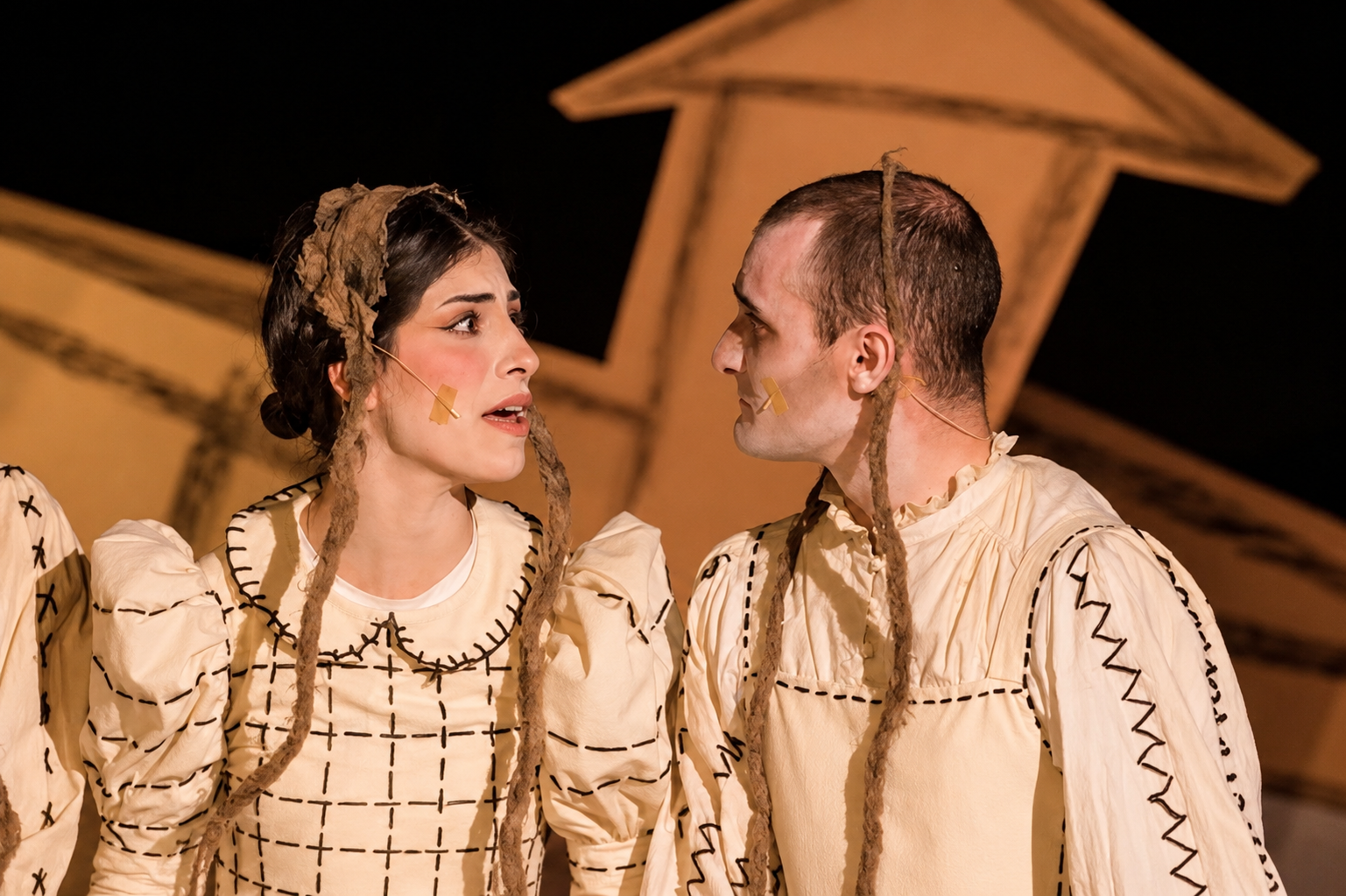
Mayar and Gil on stage at The Dybbuk performance
Gil admits there were times he didn’t feel comfortable expressing his views, and some disagreements strained even close friendships.
“There were moments when my classmates and I, we really took space from each other,” he recalls.
But the nature of theater made permanent distance impossible, and the students had to find a way to move forward. “We had to readjust and re-understand how to progress … and still appreciate each other as people, colleagues, and fellow students,” Gil reflects. For him, that change was reflected in his relationships with Arab classmates, including students from Nazareth. Conversations that initially felt impossible gradually gave way to simple acts of concern, such as asking how one’s doing or visiting a sick classmate.
Learning to Disagree
Prof. Lipshitz knew his students arrived with vastly different personal and political perspectives. Rather than trying to erase disagreement, he focused on creating an environment where difficult conversations could happen without overwhelming the class.
“There were tensions, of course. Some classes decided together that the classroom should remain a protected learning space and not become overwhelmed by outside politics,” Lipshitz says.
“The challenge is creating a space where people feel they belong without turning every class into a political argument.
I try to present the material as fully and honestly as possible, knowing I’ll still miss things and people from all sides may disagree with me.” His goal, he explains, is not consensus. “None of us are entirely comfortable, and that’s okay.”
Interestingly, the debates that proved most heated were often the least expected. “I’d think the class on Palestinian theater would provoke the biggest debate,” Prof. Lipshitz says. “Instead, a discussion about Mizrahi representation in theater would generate the strongest reactions.” Not every discussion ended neatly. Some students chose to continue conversations privately after class rather than speaking publicly. But they kept returning—to class, to rehearsals, and to one another. “And in this, I think, we succeeded in building trust,” Prof. Lipshitz reflects.
For Mayar, that trust was built just as much through everyday life as through performances. “We’re a close-knit group, and we’re here every day, morning till night. Over the years we became a family.” The friendships she formed crossed linguistic, cultural, and political lines. “I don’t like to categorize people and choose my friends based on the category they’re in,” she says. “I like to look at the person for who they are.”
Even misunderstandings became opportunities to grow. “Sometimes people accidentally hurt each other,” Mayar reflects. “But we talk about things together. We solve problems together. And when it works out, it’s beautiful.”
Lipshitz is careful not to describe the department as a utopia. Disagreements remain. So does discomfort. But after years of watching students creating together, he has come to believe that coexistence is not a defined set of rules:
“If students believe we’re here to learn from each other rather than erase one another,” he says, “then meaningful dialogue becomes possible.”
A Work in Progress
For many students, returning to rehearsals also became part of recovering from the trauma of war. The theater offered not only a place to create, but a place to reconnect—with themselves and with one another.
Gil believes that Israeli society needs more spaces where people can genuinely interact across differences. “There has to be more than just war,” he says. “There has to be more than a military culture.” Theater, he believes, offers one possible path.
Mayar shares that sentiment. “I think if people open their minds and see the beauty that’s out there [in each person], they really could live together,” she says. “It is possible.”