


To Infinity and Beyond: Tel Aviv University Launches New Space Engineering Center
“Space is no longer a distant destination; it is humanity’s next arena of activity, and we are proud to be among those shaping its future.”
A small step for humanity, a giant leap for Tel Aviv University.
The Iby and Aladar Fleischman Faculty of Engineering this week inaugurated the Space Engineering Center (SEC), a new initiative that will bring together research, development, and training in the fields of space and satellite engineering, while serving as a focal point for collaboration between academia, industry, and the defense sector.
The launch comes amid rapid growth in Israel’s space industry and increasing demand for engineers and researchers in the field. According to the center’s director, Prof. Meir Ariel, its mission is “to make a significant contribution to Israel’s security, the Israeli space industry, and the advancement of human knowledge.”
Bringing Together Science, Engineering, and Technology
The inauguration ceremony was attended by Tel Aviv University President Prof. Ariel Porat; Dean of the Faculty of Engineering Prof. Noam Eliaz; and the Space Engineering Center research team, including Prof. Meir Ariel, Prof. Ofer Amrani, Prof. Viacheslav (Slava) Krylov, Dr. Lior Medina, and Prof. Ronen Verker.
In his remarks, Prof. Porat praised the Faculty of Engineering and its contributions to Israel’s security, emphasizing the importance of the new center to the university as a whole.
“There is no field on campus that cannot, in some interesting way, connect to space,” he said.
Alongside his remarks on the future of Israel’s space sector, Prof. Porat also reflected on a personal connection to the center’s founding. He spoke about Dan Ariel, the son of Prof. Meir Ariel, who was murdered at the Nova music festival on October 7.
“He loved space and was fascinated by it,” said Prof. Porat. “It is possible that he himself would have become a researcher in the field.”
In his address, Prof. Eliaz highlighted the center’s activities and ambitions.
“The common denominator of all this research is its potential to transform groundbreaking ideas and discoveries into actual space systems and satellites built here at the Faculty of Engineering,” he said.
Prof. Eliaz also noted that former NASA astronaut and current NASA Deputy Administrator Robert Cabana recently described the Faculty of Engineering as “among the leaders in the field in global academia.” He added that Uri Oron, Director General of the Israel Space Agency, has emphasized that many countries still lack technological capabilities that have already been developed in Israel.
“We do not conduct research for the sake of research alone,” Prof. Eliaz said. “The outcomes of our work ultimately find their way into operational systems.”
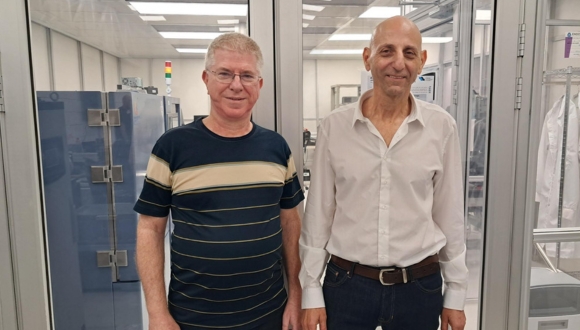
Prof. Meir Ariel, Head of the Space Engineering Center, and Prof. Noam Eliaz, Dean of the Faculty of Engineering
No Shortcuts in Space
According to Prof. Ariel, the new center, described as “a very important institution within Israel’s space sector”, includes advanced infrastructure that provides a complete academic and technological ecosystem, supporting projects from the earliest research concept all the way to operational space systems.
“The standards we, as an academic institution, must meet are no lower than those of a company like SpaceX, because in space there are no shortcuts.”
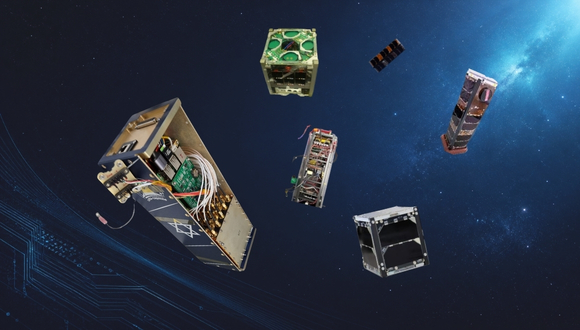
Some of the satellites and technologies developed by the Space Engineering Center
In addition to testing space systems and nanosatellites, the center enables researchers to carry out most stages of development and validation under one roof. Its capabilities include:
- Building satellites up to ten times larger than those previously constructed at Tel Aviv University.
- Simulating extreme space environments, including severe temperature and pressure fluctuations.
- Operating an independent ground station that communicates with satellites, sends commands, and receives scientific data.
The center emphasizes multidisciplinary research spanning electrical engineering, computer science, mechanical engineering, materials science, and related fields. Current research includes:
- Advanced communication and cybersecurity technologies, including encryption systems designed to withstand future computing capabilities.
- In-space manufacturing and large-scale 3D printing of structures directly in orbit—a unique area of expertise at Tel Aviv University.
- Smart sensor systems capable of processing data before transmission to central computing systems.
- Sensing technologies that capture and analyze the electromagnetic spectrum—including visible, infrared, and ultraviolet light—for applications ranging from pollution detection and precision agriculture to space exploration.
“The laboratory’s motto is: things are impossible, until they aren’t.”
From the Periphery to Mars
Beyond research, the Space Engineering Center plays a central role in education, supporting students from high schools across Israel through advanced academic training.
As part of the Faculty of Engineering’s mission to make science and technology more accessible, Tel Aviv University has established approximately 15 clean rooms and ground stations in communities across the country, including Sha’ar HaNegev, Ma’ale Adumim, Givat Shmuel, Tayibe, Kafr Qara, Ein Mahil, and Yarka.
At these centers, outstanding high school students build nanosatellites as part of the Israel Space Agency’s Tevel 2 initiative, developing systems for both scientific and operational purposes. As part of the project, students successfully built an observation satellite capable of capturing images of Earth from space.
On the international stage, students participating in the center’s TAUverIL program are currently competing in a global rover-design competition in Poland that simulates the terrain and challenges of Mars exploration.
Prof. Ariel and Prof. Amrani also announced the launch of a new Space Engineering specialization within an interdisciplinary research-based master’s degree program. The specialization will integrate studies in electrical and computer engineering, mechanical engineering, and materials engineering.
Students in the program will complete dedicated space-related coursework and conduct a research thesis in the field. Upon graduation, they will receive both their master’s degree and a certificate recognizing their specialization in space engineering.
Together, these initiatives position the Space Engineering Center not only as a platform for research and innovation, but also as a national center of excellence in science, engineering, and technology.
As Prof. Eliaz concluded:
“Space is no longer a distant destination. It is humanity’s next arena of activity, and we are proud to be among those shaping its future.”
Watch highlights from the Space Engineering Center over the years: