


“What First, What Last Shall I Tell?”: The Odyssey’s Journey from Storytelling to the Silver Screen
Why does the oldest surviving work of Western literature continue to inspire new adaptations? As Christopher Nolan’s The Odyssey arrives in theaters, a Tel Aviv University classicist explains how the epic has been reinventing itself for nearly 3,000 years.
Nearly three thousand years after it was composed, The Odyssey continues to find new audiences.
Christopher Nolan’s upcoming film is only the latest chapter in a long history of reinterpretation that began long before the epic was ever written down. For generations, the story was passed from one storyteller to another, changing with each performance and adapting to each new audience.
To understand why artists continue to return to The Odyssey, we first need to understand how it came into being: as a work that was never meant to exist in just one definitive version.
Why Has The Odyssey Endured?
The Odyssey, traditionally attributed to Homer, was composed sometime in the late eighth or early seventh century BCE. While The Iliad tells the story of the Trojan War, The Odyssey follows Odysseus’ long journey home to Ithaca after the war.
According to Dr. Teddy Fassberg of the Department of Classical Studies – Greece and Rome at the Lester and Sally Entin Faculty of Humanities, this may be one reason the epic continues to resonate today.
“Perhaps it has survived because it deals with more universal themes—home, and the attempt to return to it.”
Dr. Fassberg also notes that The Odyssey presents “a much more diverse world—a world that includes women and people from lower social classes. It’s not a world populated only by heroes,” making it easier for modern readers and creators to discover new points of connection.
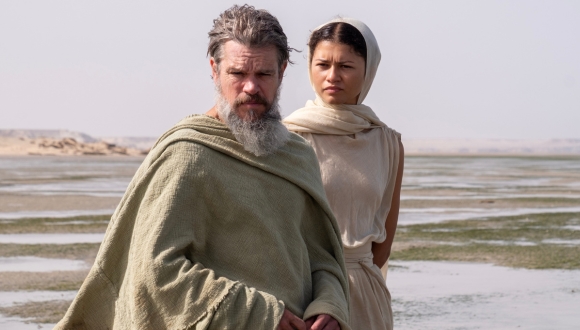
Zendaya as Athena and Matt Damon as Odysseus in The Odyssey (Courtesy of Tulip Entertainment)
A Story Meant to Be Told
One of the most important things to remember, says Dr. Fassberg, is that The Odyssey was never intended to be silently read from a book.
For generations it was performed aloud before audiences, with storytellers adapting it as they went—expanding dramatic moments, shortening lengthy passages, and occasionally changing details to keep listeners engaged.
According to Dr. Fassberg, Homer himself was already “adapting and reshaping a story that goes much further back.”
In that sense, Odysseus is himself a master storyteller. Throughout the epic, he knows how to shape his narrative for different audiences, when to pause at the height of suspense, and when to reveal the next crucial detail.
Dr. Fassberg even jokingly calls him “a marketer.”
“Within the story, Odysseus stops his tale at the height of the suspense—a cliffhanger—to persuade his audience to give him more gifts.”
Modern adaptations, then, are not departures from the original—they are the continuation of a tradition that began in antiquity.
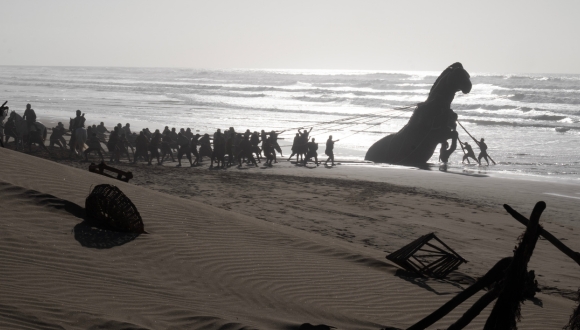
The Trojans bring the Trojan Horse into the city, following Odysseus’ ingenious plan (Courtesy of Tulip Entertainment)
Reinventing The Odyssey
Over the past several decades, The Odyssey has inspired countless reinterpretations across literature, cinema, and translation.
The Coen Brothers relocated Odysseus’ journey to Depression-era America in O Brother, Where Art Thou? Margaret Atwood retold the story from Penelope’s perspective in The Penelopiad. In 2017, Emily Wilson published the first English translation of the epic by a woman.
Now Christopher Nolan joins that tradition with his own cinematic adaptation, set to be released in Israel on July 16, 2026.
Even before its release, however, the film has generated debate over its casting choices and interpretation.
One of the most discussed decisions was Nolan’s casting of rapper Travis Scott as the bard in Odysseus’ palace—a relatively minor figure in the epic. Nolan explained that the choice was intended to evoke the poem’s origins as an oral performance, drawing a parallel between ancient epic recitation and modern rap.
Discussion has also centered on Nolan’s decision to give the characters American accents—even when portrayed by British actors such as Tom Holland (Telemachus) and Robert Pattinson (Antinous).
Particular attention was drawn to a trailer in which Telemachus refers to Odysseus as “Dad,” while Antinous mockingly calls him “Daddy.” Some viewers argued that the modern American slang felt out of place in ancient Greece.
Nolan defended the choice, explaining that he wanted to find “a language that carries emotional meaning, not just intellectual meaning, for the audience.” Rather than using elevated or theatrical dialogue, he preferred contemporary speech.
“Maybe I was naïve, and maybe it’ll come back to haunt me,” he said. “But I wanted a story that felt earthy and human. To me, it was the obvious choice.”

Robert Pattinson as Antinous, one of Penelope’s suitors (Courtesy of Tulip Entertainment)
A Story That Invites Reinvention
For Dr. Fassberg, these debates are exactly what has kept The Odyssey alive for nearly three millennia.
“If there is one work that justifies adaptations that take creative liberties, it’s The Odyssey.”
He adds:
“I think Homer would have identified with Christopher Nolan. We see Odysseus using exactly the same storytelling devices that people criticize Nolan for using today.”
Perhaps that is why, nearly 3,000 years after it was first told, The Odyssey continues to spark debate, inspire reinterpretation, and find new audiences. Precisely because it has never had a single definitive version, it has never stopped evolving.